


Maths
At Elaine Primary, we deliver a highly ambitious and inclusive mathematics curriculum designed to empower all children to become confident, competent, and resilient mathematicians. Underpinned by our commitment to social justice and educational excellence, our mastery approach ensures that every child—regardless of their starting point—develops a deep, lasting conceptual understanding of mathematics. We believe that all pupils can achieve in mathematics, and we structure our teaching sequence carefully to secure foundational fluency, eliminate cognitive overload, and push children into zones of deep mathematical reasoning and critical thinking.
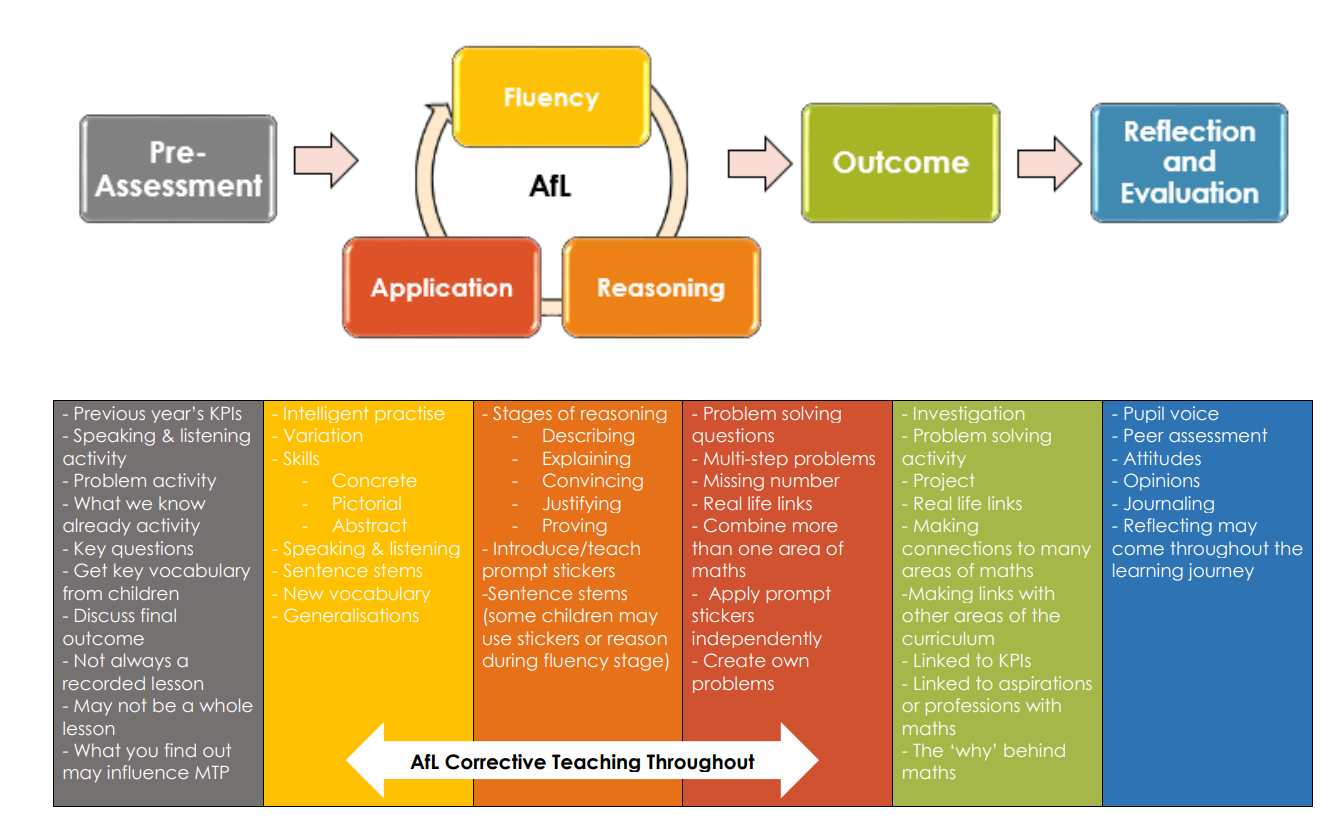
Our mathematics curriculum is structured to move children systematically from concrete experiences to abstract mathematical concepts:
- The Concrete-Pictorial-Abstract (CPA) Approach: We build secure conceptual foundations by introducing new mathematical ideas through concrete manipulatives (such as Dienes, tens frames, and place value counters). As children’s understanding secures, they transition to pictorial representations (such as bar models and part-part-whole diagrams) before mastering abstract notation. This ensures mathematical concepts are deeply understood rather than memorised by rote.
- Sustained Conceptual Depth: We design learning sequences in small, carefully planned steps to ensure that no child is left behind. Rather than accelerating higher-attaining pupils prematurely into larger numbers, we challenge them to deepen their understanding through complex, open-ended problem-solving and structured reasoning.
- Mathematical Language and Oracy: We explicitly teach and expect children to use precise mathematical vocabulary. Pupils are taught to structurally justify their answers using speaking frames such as I know this because... or If I know this, then I also know... to build metacognitive awareness and mathematical confidence.
Securing Foundational Fluency
To reduce cognitive load and free up working memory for complex problem-solving, we place a relentless focus on securing rapid recall of fundamental number facts:
- The 10-Minute Daily Number Fluency Block: Delivered across Key Stage 1 and Lower Key Stage 2, this non-negotiable daily session is dedicated entirely to the rapid retrieval and automation of key addition, subtraction, and multiplication facts.
Critical Thinking and Mathematical Reasoning
Critical thinking is systematically integrated into our daily maths lessons to foster independence and analytical stamina:
- Cognitive Conflict Prompts: Our lessons regularly feature Always, Sometimes, Never or What if? queries that challenge children to test mathematical rules, find exceptions, and prove their arguments systematically.
- Collaborative Problem-Solving: Using collaborative structures, pupils work in pairs and small teams to dissect multi-step reasoning problems, comparing strategies and evaluating the most efficient mathematical pathways.
Our mathematics provision is designed to close gaps immediately and ensure equitable progress for our disadvantaged cohort and pupils with SEND:
- Live Misconception Surgeries: Teachers use mini-whiteboards and rapid exit tickets to identify conceptual errors in real-time, executing immediate revisit-and-reteach cycles before the lesson ends to prevent gaps from widening.
- Same-Day Micro-Interventions: We build flexible daily windows into our timetable, allowing staff to deliver targeted, same-day micro-interventions for children who missed a key benchmark, securing their readiness for the next step of learning.

CALCULATION POLICY
Please find the calculation policy link here. This is a useful tool for parents when supporting their children at home with maths. The document takes you through each year group and the methods we use, with a step-by-step approach to teaching each of the four operations.
USEFUL LINKS
At Elaine Primary, we believe that parents and carers are our most valuable partners in securing educational excellence. When it comes to mathematics, supporting your child at home does not require you to be an expert. Instead, the most impactful thing you can do is help your child build short, daily habits of mathematical talk and play.
Our school-wide Mastery Approach is designed to eliminate cognitive overload. By practising number facts, subitising, and multiplication tables for just 5 to 10 minutes each day, you help your child automate these basic skills. This frees up their active working memory to tackle more complex mathematical reasoning and problem-solving in their daily classroom lessons.
Below is a directory of the official, school-supported digital platforms and free resources that you can use at home to support your child’s learning journey.
1. Times Tables Rock Stars (TTRS)
For Years 2 to 6
This is our primary digital tool for developing rapid, accurate recall of multiplication and division facts. Daily practice on TTRS is crucial, particularly for pupils in Year 3 and Year 4 as they build stamina towards the statutory National Multiplication Tables Check (MTC).
- The Focus: Building recall speed and accuracy through competitive, engaging, and personalised game modes.
- How Parents Can Help: Encourage your child to complete at least three "Soundcheck" sessions (which simulate the exact layout of the national Year 4 check) each week.
- Login Webpage: Times Tables Rock Stars Login
2. Century Learning
For Years 3 to 6
Century is an advanced, adaptive learning platform powered by artificial intelligence. It analyses your child's mathematical strengths and areas for development, creating a highly personalised study path consisting of short, micro-lessons called nuggets.
- The Focus: Addressing individual gaps in learning and stretching pupils who are ready for greater depth and conceptual challenge.
- How Parents Can Help: Sit alongside your child as they complete their recommended maths nuggets. If they make an error, encourage them to watch the short, supportive instructional video built directly into the nugget.
- Login Webpage: Century Tech Student Portal
3. Purple Mash
For Years 1 to 6
Purple Mash is a creative educational portal containing a vast suite of mathematical games, virtual manipulatives, and structured homework tasks.
- The Focus: Developing foundational maths skills, early coding, and mathematical representations through play-based digital activities.
- How Parents Can Help: Check the 2Do tab on your child’s homepage weekly to complete tasks assigned directly by their class teacher.
- Login Webpage: Purple Mash Elaine Primary Academy Portal (Please contact the school office if you need a copy of your child's unique QR code login card).
4. White Rose Maths: Parent Resources
For All Year Groups
White Rose provides a wealth of free parent resources that explain the representations (such as bar models and part-part-whole diagrams) we use in the classroom.
- Free Digital Workbooks: You can download free Parent Workbook PDFs for every term and block of study, allowing your child to practice concepts that match their current classroom learning.
- Home Learning Video Series: Features short, clear videos designed to explain mathematical methods simply, helping you feel confident as a co-educator.
- Webpage: White Rose Maths Parent Guides & Workbooks
5. 1-Minute Maths App (White Rose)
For Early Years and Key Stage 1
Created by White Rose Maths, this is a free, highly visual mobile app designed specifically for our youngest learners. It contains zero advertisements and does not require a login.
- The Focus: Securing early number fluency, including subitising (the ability to recognise an amount of objects without counting them), addition, subtraction, and sub-base ten composition.
- How Parents Can Help: Spend 1 minute a day playing these rapid-fire game blocks with your child during transition points—such as on the journey to school or before dinner.
- App Store Links: Available for free download on the Apple App Store, Google Play Store, and Amazon Appstore.
Practical Home Tips
You do not need digital screens to make maths a meaningful part of your home life. Try integrating these quick, low-cost activities into your daily routines:
- In the Kitchen: Ask your child to help you weigh ingredients or measure volumes of liquid. Discuss fractions by cutting a pizza or cake into equal parts.
- At the Supermarket: Encourage your child to find the cheapest item on a shelf by comparing prices. Challenge older children to estimate the total cost of 3 or 4 items.
- Out and About: Look for numbers on doors and road signs. Practice counting in multiples of 2, 5, or 10 as you walk.
- Telling the Time: Refer to analogue clocks in the home. Ask questions such as: It is 4 o'clock now, what time will it be in half an hour? to build time-conversion fluency.