
Teaching and Learning
At Elaine Primary School, we provide inclusive learning experiences for every stage of a child’s development. Our approach is underpinned by our attachment and trauma-informed ethos, where we create safe, structured, and predictable spaces that allow all children to flourish. We are committed to social justice, ensuring that high-quality adaptive teaching, live feedback, and relational care remove barriers to learning so that starting points never limit a pupil’s potential. We believe that all learners are capable of academic excellence and personal growth, and we design our curriculum to make this a reality.
Early Years Foundation Stage: Early Excellence
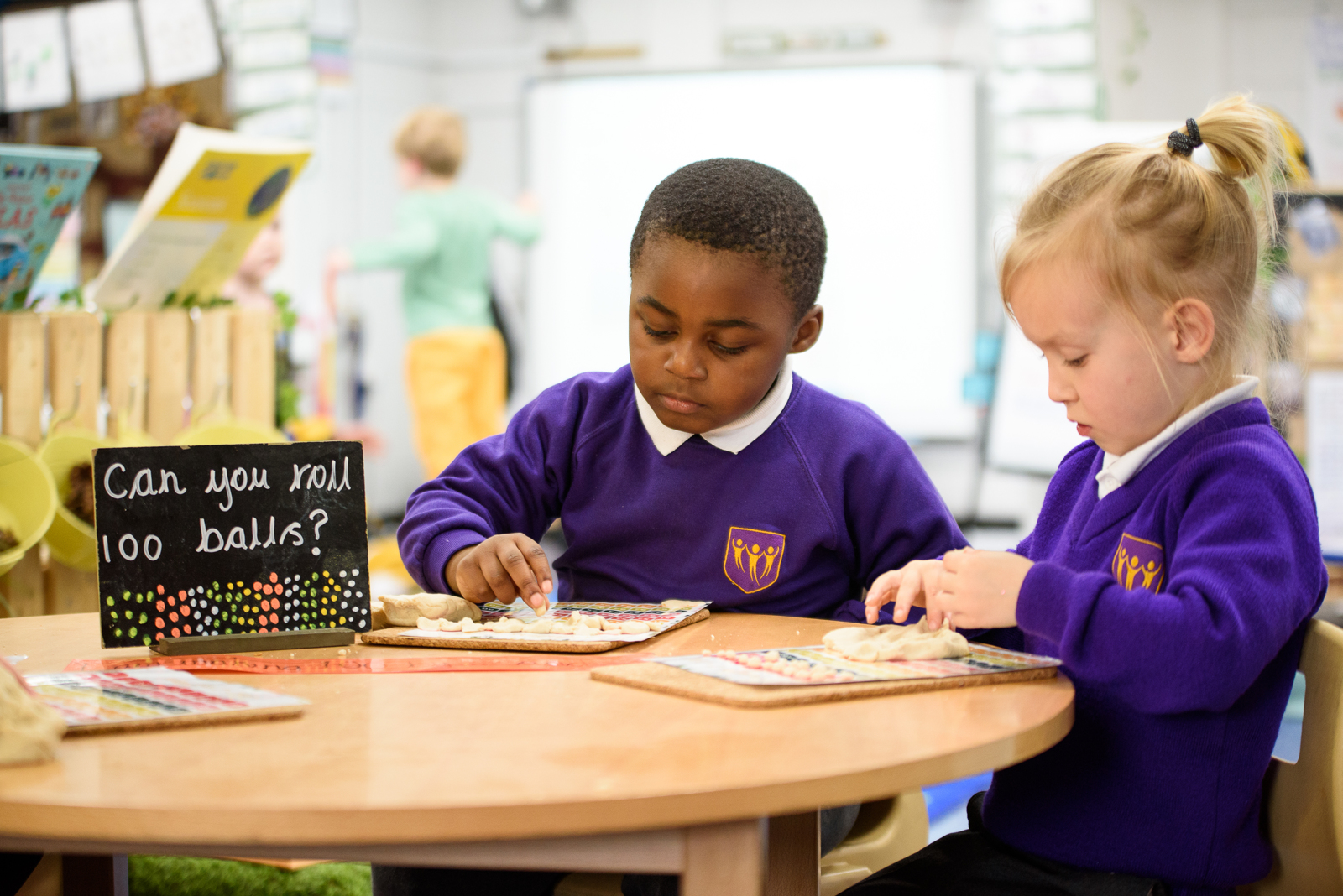
In the Early Years, we build secure foundations in language, communication, and early literacy within a language-rich environment. Our curriculum prioritises oracy and vocabulary development, utilising our structured Oracy Framework to build children’s confidence. Children learn through a balanced mixture of structured adult-led sessions and high-quality continuous provision, both indoors and outdoors.
Play-based collaborative interactions and exciting, hands-on provocations—such as exploring alchemy in the potion station, digging for treasure in the large sandpit, or developing a curiosity for the natural world in our forest school—are designed purposefully to foster independence, curiosity, and early mathematical reasoning. Meticulous, early diagnostic profiling ensures that children with Special Educational Needs and Disabilities (SEND) receive timely, targeted support, while our rigorous Little Wandle phonics programme gets every child reading from the very beginning of their journey.
Key Stage 1: Securing Strong Foundations
In Key Stage 1, we secure a smooth and worry-free start to formal learning through carefully planned, shared-responsibility transitions. Our teachers track essential developmental milestones like pencil grip, sitting stamina, and phonetic Grapheme-Phoneme Correspondence (GPC) knowledge, ensuring no progress is lost as pupils move to more formal desks.
Oracy remains at the heart of our curriculum, with daily active sessions encouraging children to articulate their thinking, compose sentences orally, and expand their vocabulary. The curriculum is kept highly ambitious and broad, enriched by trips, visits, and real-world experiences. We eliminate cognitive overload by focusing on core transcription mechanics, daily handwriting practice, and a non-negotiable ten-minute Daily Number Fluency block that secures rapid retrieval of fundamental number facts.
Key Stage 2: Attainment and Ambition
In Key Stage 2, children develop the maturity, character, and academic stamina required for a successful transition to secondary school. Our pupils grow into confident, articulate, and compassionate global citizens who actively contribute to their community and the wider world. Placing relationships and mutual respect at the heart of our practice, we use collaborative learning and Kagan structures to help children master complex skills.
We explicitly teach cognitive strategies and critical thinking tools—such as Why-Why-Why Chains to identify root causes and the Opinion Continuum to debate and explore diverse viewpoints. Through our ambitious Inspire Global Curriculum, learning is sequenced to encourage long-term retention, reasoning, and evaluation. Our curriculum is further enriched by high-impact STEAM projects, such as the Young Eco Engineers initiative where Year 6 pupils work alongside professional engineers to build and race a Goblin electric car, showing children the real-world value of their academic achievements.
Visible Learning
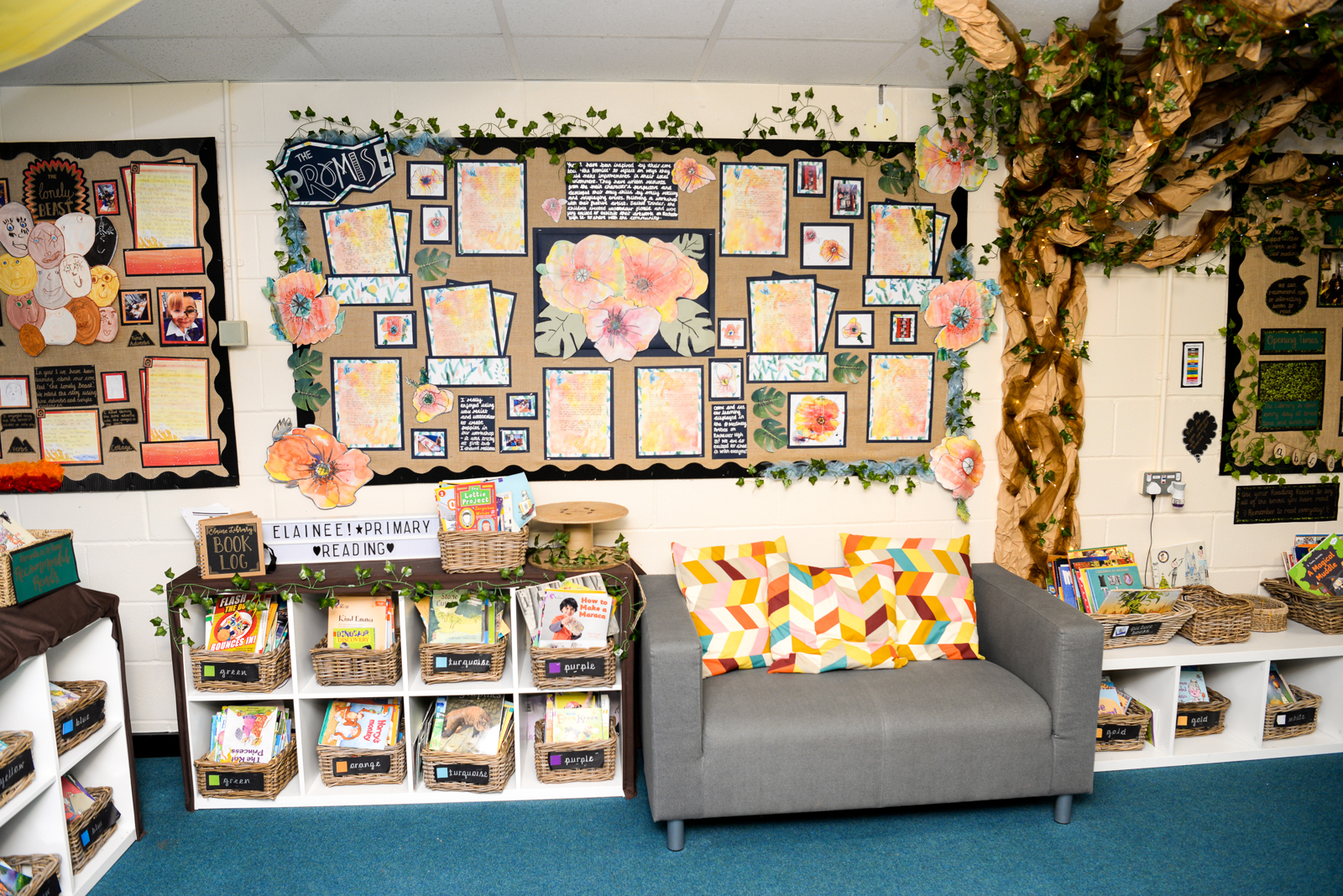
At Elaine Primary School, we believe our physical environment acts as an active resource that cultivates a deep connection to learning and promotes our school-wide ethic of excellence. Every classroom is consistently and purposefully organised to reflect our ambitious, global curriculum, providing a calm, highly structured, and low-arousal space that maximises pupil attention and reduces cognitive load.
Our classroom environments make learning visible and interactive through three key features:
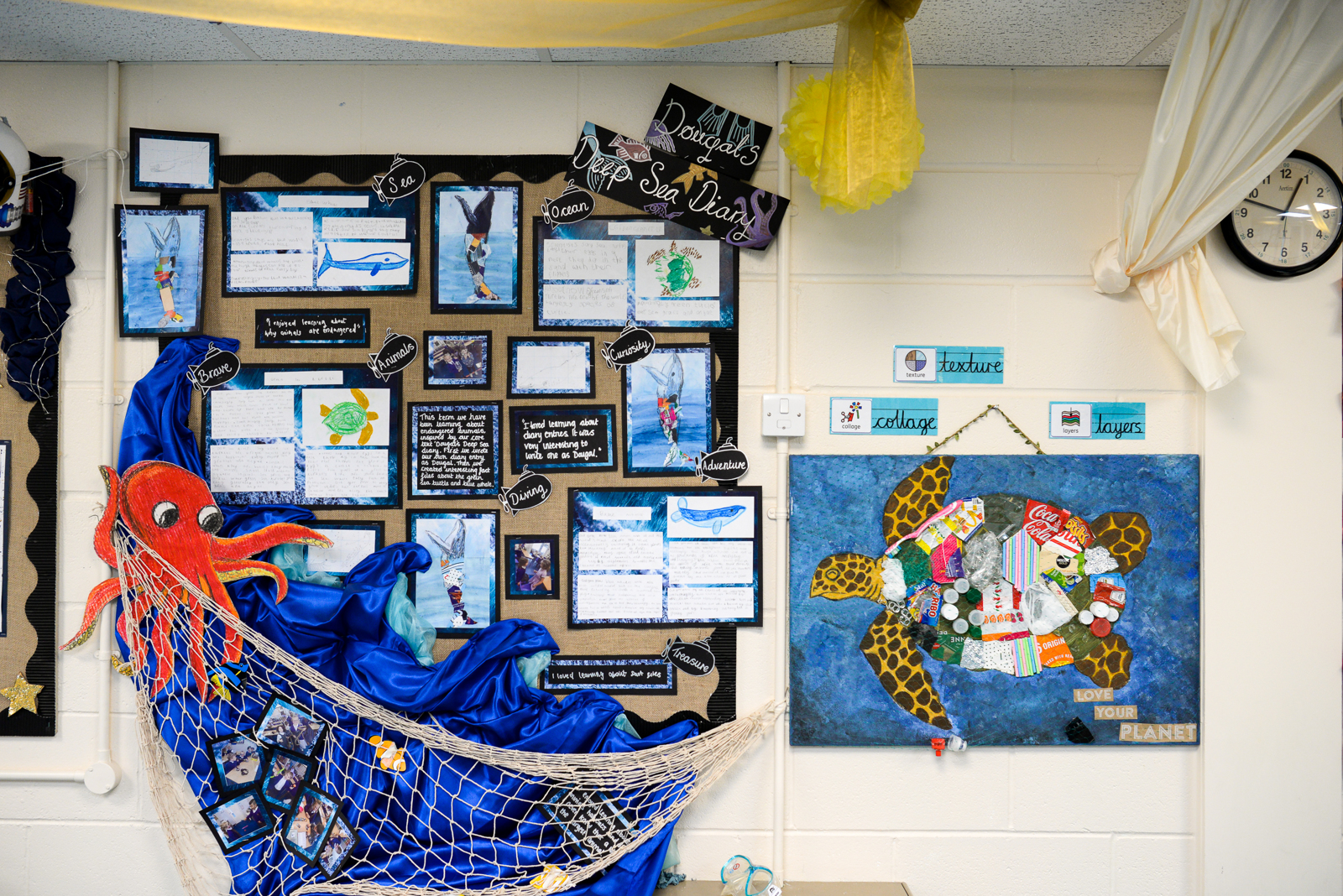
- Interactive Learning Journeys: Our learning walls are dynamic process boards rather than static displays. They visually map out the sequence of learning, featuring explicitly displayed teacher modelling and vocabulary scaffolding that pupils actively use to guide their independent work.
- Curious Topic Tables and Doorways to Learning: Each unit of learning is launched with hands-on, termly-updated displays filled with curious artefacts, high-quality core texts, and evocative images. These act as exciting provocations, designed to spark curiosity and invite children to explore the topic first-hand.
- We use our environments to actively push pupils into zones of cognitive challenge. Classrooms feature interactive prompts displaying our signature critical thinking tools—such as Why-Why-Why Chains to identify root causes, Perspective Glasses to develop empathy, and the Opinion Continuum to debate opposing views. These scaffolds empower our children to think critically, challenge assumptions, and confidently justify their own reasoning.
Oracy
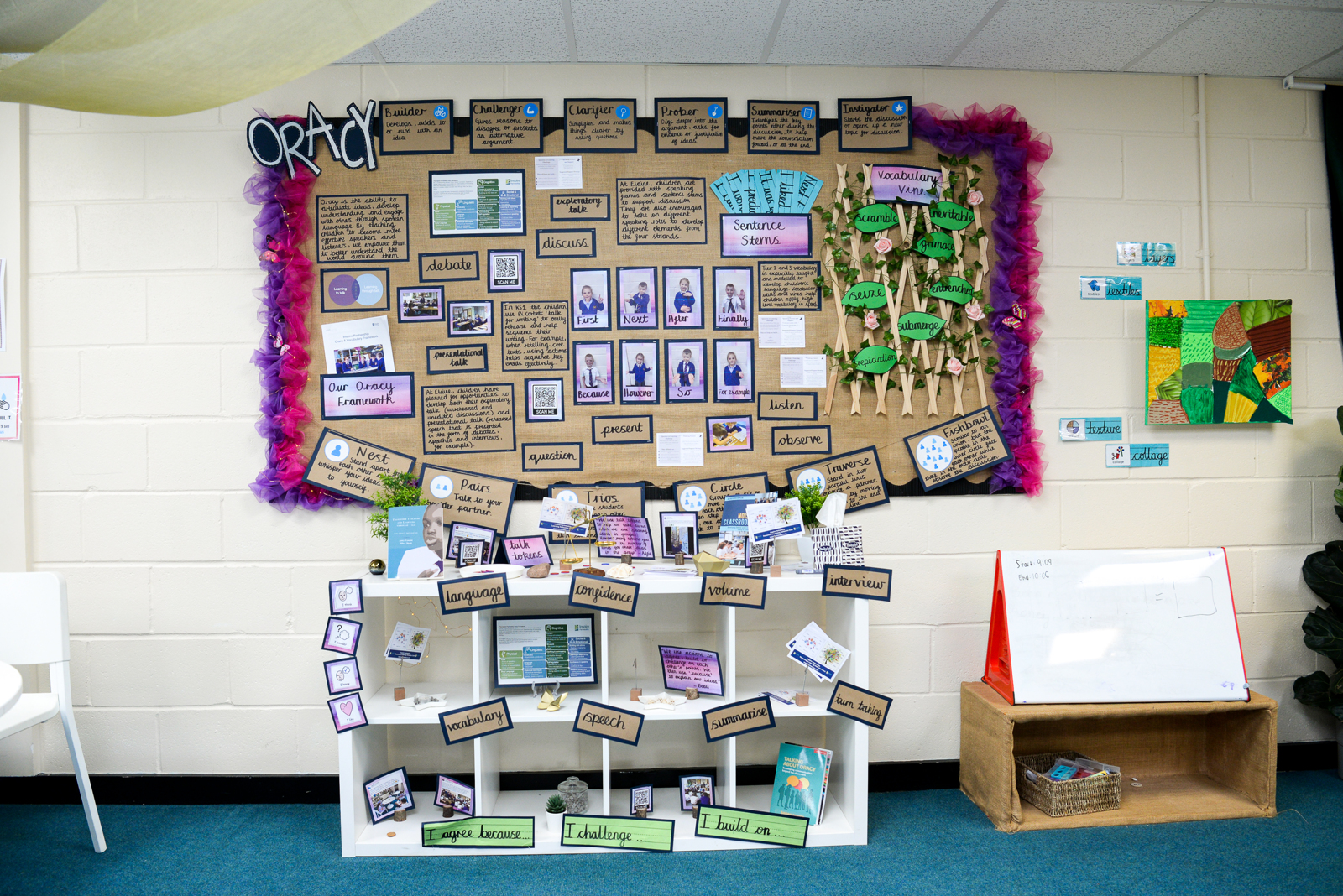
At Elaine Primary School, we define oracy as the ability to articulate ideas, develop a deep understanding of concepts, and engage respectfully with others through spoken language. Spoken language is the absolute bedrock of thinking, learning, and cognitive development. By explicitly teaching our children to become highly effective speakers and listeners, we empower them to understand themselves, build meaningful relationships, and navigate the wider world with confidence.
Learning Through Talk and To Talk
Our curriculum is designed so that children learn both through talk and to talk. We do not leave communication to chance; instead, we systematically organise our classrooms to promote rich, dialogic talk using the school's structured Oracy Framework. This means classroom talk is purposefully planned, designed, modelled, and scaffolded.
Through the use of collaborative Kagan structures, tiered vocabulary, and structured speaking frames, we ensure that all pupils—especially those starting from low language baselines—acquire the linguistic tools and social confidence to express themselves clearly and justify their opinions.
The Four Strands of Oracy
We explicitly teach and assess the four key strands of oracy: the physical, linguistic, cognitive, and social-emotional skills of communication. Our classrooms are vibrant, talk-rich environments where children are exposed to high-quality interactions. They learn how to:
- Listen with focus and intent, showing empathy and validating the feelings of others.
- Speak with clarity and purpose, adapting their vocabulary and tone to suit different audiences and contexts.
- Engage in cognitive conflict and reasoned debate, using precise language to challenge assumptions and co-construct learning.
- Utilise critical thinking tools, such as Why-Why-Why Chains to identify root causes and the Opinion Continuum to explore diverse viewpoints.
By prioritising these skills, we ensure that a child's early reading fluency, writing composition, and mathematical reasoning are built on a solid foundation of spoken language.
Growth Mindset & Character Skills
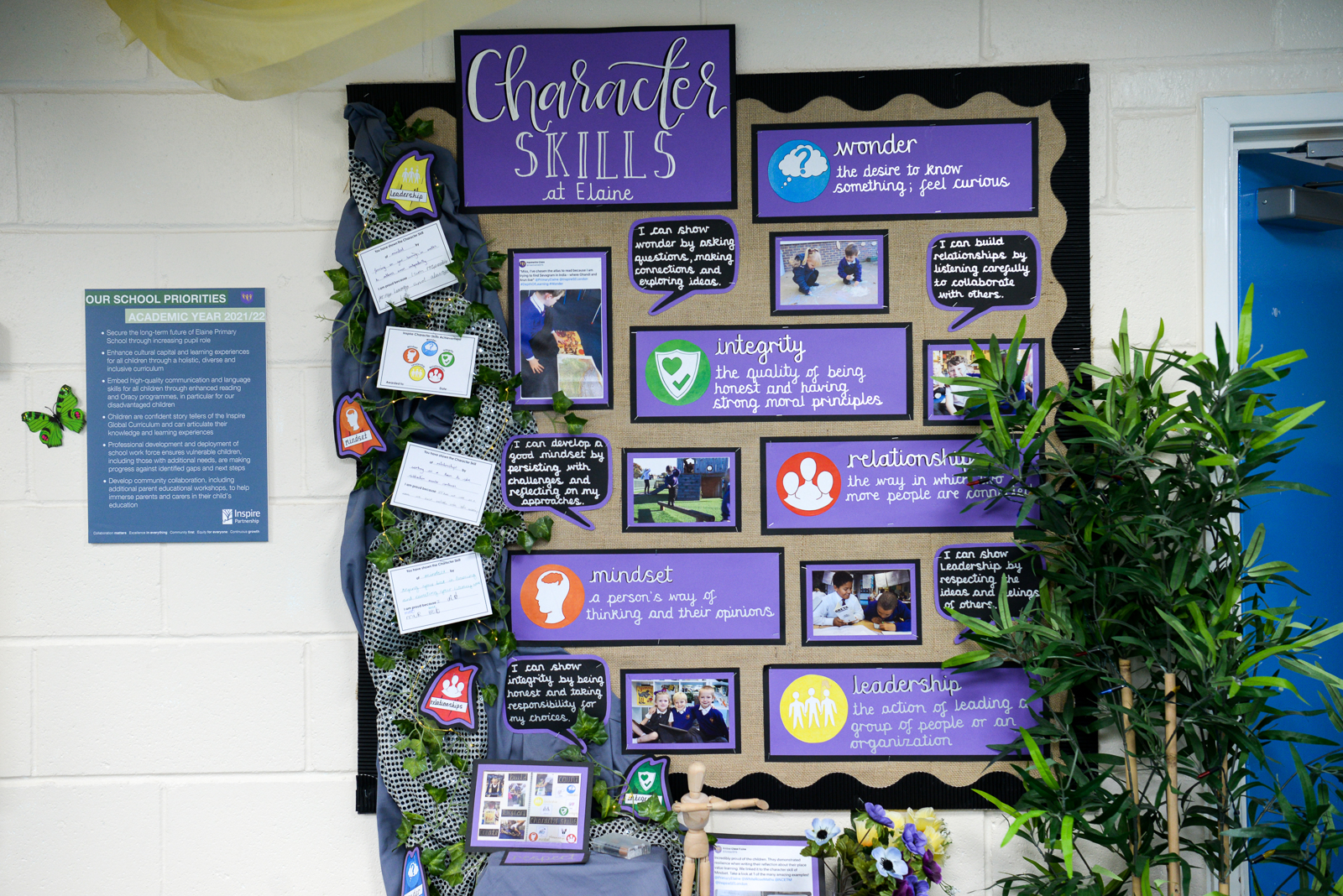
We recognise that the relationship between success and soft skills is equally as important as the tangible skills and knowledge gained from a quality education. With this in mind, we ensure that Character Skills are explicitly taught, providing children with the skills needed to be successful members of the local and global community in the 21st century.
The five overarching skills, Wonder, Integrity, Leadership, Relationships, and Mindset are woven into lessons to ensure pupils develop strength of character through our values-based curriculum. We believe that all children have the capacity to achieve and actively teach a growth mindset, encouraging resilience and a can-do attitude.
Research
At Elaine, we believe that high-quality, continuous professional development is the primary lever for achieving social justice and securing exceptional outcomes for our pupils. Our learning-led culture is built upon a foundation of trust, collaboration, and psychological safety, moving away from top-down accountability toward a shared commitment to continuous improvement. We frame our educators as active researchers, empowered to translate high-quality pedagogical evidence into highly effective classroom practice.
Leadership at Every Level
Underpinned by the Inspire Inclusive Education Leadership Framework (IELF), we champion the belief that everyone is a leader because everyone influences someone. We intentionally build leadership capacity across the school, supporting middle and phase leaders to move beyond operational management to drive strategic, subject-specific curriculum impact. By balancing the needs of the task, the team, and the individual, our collaborative alliance of leaders ensures that educational excellence is a lived, daily experience in every classroom.
Assessment
The principles that underpin our assessment system are:
- Every child can achieve: teachers at Elaine have the mindset: What do I need to do next to enable a child in my class to achieve?'
- Learners will be assessed against Key Performance Indicators (KPI's) for each subject
- Well planned, teaching sequences across the curriculum will be carefully scaffolded drawing on the National Curriculum objectives, leading to assessment of the KPI's
- Children will make age-appropriate progress; the focus will be on moving learners through each year group at the same rate to ensure learners leave each year group at age-related expectations
In order to be ‘secondary ready’, children need to meet statutory assessment judgements at the end of KS2. We use KPI’s to assess outcomes for children at the end of each curriculum year, for example:
A child that has achieved all the KPI’s set out for Year 3 for English would be said to be working at the expected level for English at the end of Year 3. A child achieving half of the mathematics KPI’s for Year 5 would be classed as working towards the age-related expectation for maths.
Reporting
- Ongoing assessment in lessons through mini-plenaries, carefully planned questioning and reasoning opportunities (including the use of learning reflection postcards and depth prompts) will be effectively used to ensure the correct scaffolding is built into lessons to ensure all children achieve
- Children will know what they are learning and, more importantly, why; they will become increasingly confident when discussing their learning (including their useful learning mistakes)
- There will be regular feedback, both written and verbal, between the teacher and learner based on the Inspire Partnership Feedback Toolkit
- A KPI document allows the teacher and learner to know what has been achieved and the child's next learning steps
- Triangulation of data, evidence in books and pupil voice will be used to ascertain each individual child's progress
- Children who have achieved all KPI's for their year group will not move onto the next year groups curriculum, but instead will focus on deepening their learning and applying it in different contexts
EYFS Assessment
Children in Nursery and Reception will continue to be assessed against the prime and specific areas of learning in the EYFS profile. Assessments will be based on observation of daily activities and events. At the end of Reception, for each Early Learning Goal teachers will judge whether a child is meeting the level of development expected at the end of the Reception year.