


English
At Elaine, we deliver an ambitious, language-rich English curriculum that acts as a powerful vehicle for social justice and academic excellence. By equipping our pupils with exceptional reading, writing, spelling, and oracy skills, we remove barriers to learning and ensure that all children—regardless of their starting point—can communicate with clarity, confidence, and authority.
Our curriculum intent is underpinned by high-quality, culturally diverse core texts that reflect our school community, broaden horizons, and build rich cultural capital. We systematically design our teaching sequences to eliminate cognitive overload, transitioning children from early verbal mastery to advanced written composition and analytical critical thinking.
Reading
We view reading as the absolute bedrock of our entire academic offer. Our strategic reading pathway is divided into two distinct, highly aligned phases:
Early Reading and Systematic Synthetic Phonics
From their very first days in school, pupils are taught to decode with precision using the Little Wandle Letters and Sounds Revised synthetic phonics scheme.
- Meticulous Tracking and Rapid Keep-Up: We use the Little Wandle Assessment Tracker to identify children’s exact phonetic knowledge and immediately establish daily, targeted Keep-Up interventions for any child who falls behind.
- Phonetically Decodable Books: To build absolute reading confidence, books read in school and sent home are strictly matched to the child’s secure Grapheme-Phoneme Correspondence (GPC) knowledge, ensuring they can read fluently without guessing.
- Transcription and Pencil Grip Foundations: In the early stages, we prioritise fine-motor strength, pencil grip, and handwriting families alongside decoding to ensure transcription mechanics are automatic before children write.
Key Stage 2 Comprehension and Inference
As decoding becomes automatic, we transition pupils to a whole-class reading model focused on advanced language comprehension and vocabulary acquisition.
- Targeting Advanced Inference (Domain 2d): We explicitly teach pupils how to navigate complex, multi-step reading questions, teaching them to locate text evidence systematically and construct written, justified responses.
- Metacognitive Critical Thinking: Pupils use our school-wide critical thinking scaffolds, such as Perspective Glasses, to analyse authorial intent and character motivations, ensuring they move beyond literal retrieval into deep, analytical reflection.
Writing
Our writing curriculum is structured to support children to become independent, creative, and highly competent authors.
- The 6-Stage Writing Learning Journey: Mapped meticulously across our medium-term plans for Years 1 to 6, this evidence-informed journey ensures that children are deeply immersed in high-quality core texts, explore grammar and vocabulary, rehearse, draft, edit, and publish their work for a real audience.
- Oral Composition First (Say It Before You Write It): To reduce cognitive load, we mandate that all early writing begins with oral composition. Children must be able to say their sentences out loud and refine their grammar verbally before attempting to write them.
- Grammar for Impact: Rather than teaching grammar as a series of isolated checklist exercises, we teach pupils the intentional manipulation of sentence structures and punctuation to create a specific emotional impact on the reader.
Spelling, Vocabulary, and GPS Mastery
To ensure spelling does not become a barrier to independent written expression, we follow our Spelling and Vocabulary Progression Maps, which provide a clear, coherent pathway from Year 2 to Year 6.
- Systematic Rule and GPC Teaching: Our spelling lessons focus on the rules of doubling consonants, suffix morphology (such as -less, -ful, -tion), and GPC bridges from phonics.
- Etymology and Root Word Instruction: We explicitly teach root words (such as chron for chronological, or sci for science) to help children break down complex words, decode unfamiliar vocabulary across the curriculum, and master academic spelling patterns.
- Tier 2 and Tier 3 Vocabulary: High-leverage academic words (such as despise, gesture, emerge, and negotiate) are mapped across the units and explicitly taught, ensuring children use precise, sophisticated language in their writing and oracy.
Fostering a Lifelong Reading Culture
We believe that being a reader is an identity that transforms lives. We celebrate this through structured school-wide routines:
- Daily Drop Everything And Read (DEAR) Time: A non-negotiable daily window where our entire school stops to read, while adults model expressive reading and share their passion for literature.
- Pupil Reading Leadership: Highly active pupil Reading Ambassadors and Child Librarians recommend books in assemblies, run library spaces, and share reading recommendations.
- The Reading Festival: An annual celebration showcasing children’s independent writing, favourite books, and research projects, providing a platform for pupil-led vocabulary presentations.
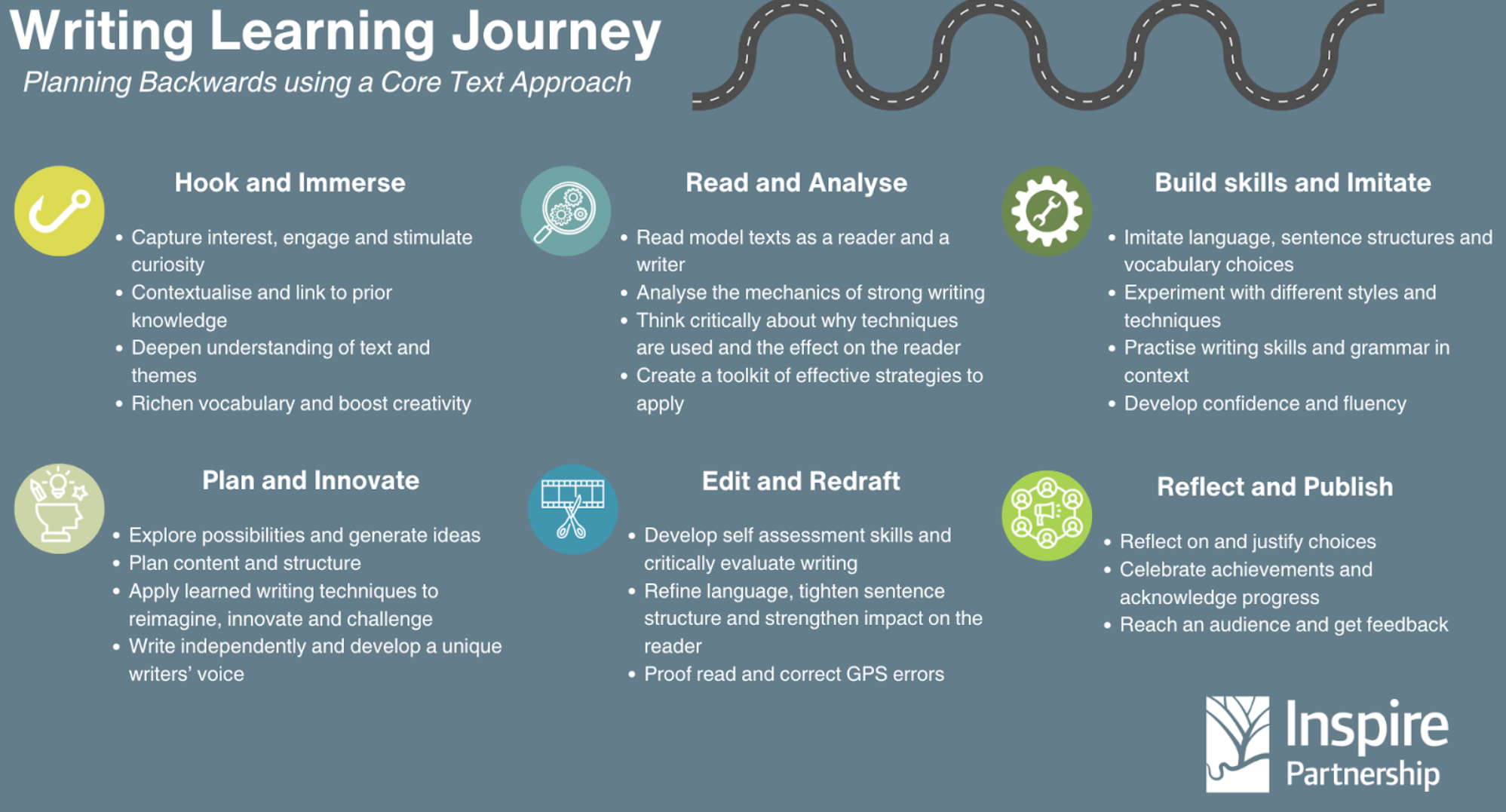
The Writing Learning Journey
We want to produce confident writers who are not afraid to take risks and are able to transfer taught skills in a variety of contexts. The children will be intrinsically motivated by a clear purpose for their writing. They will be reflective writers, assessing their own and others' writing. They will have an understanding of the purpose of their writing and the impact that their word choice and style has on the reader.
Children enjoy writing and use the features of different genres and styles. They can write for different purposes and audiences. Children are proud of their writing and know that others value their writing; they see it celebrated on displays within classrooms and in shared spaces.
Supporting English & Literacy at Home:
At Elaine Primary, we believe that parents and carers are our most essential partners in helping children master the vital life skills of reading, writing, and communication. You do not need to be a literary expert to make a profound difference at home. By embedding just 5 to 10 minutes of daily talk, wordplay, and shared reading into your family routines, you help your child build the vocabulary, phonetic security, and confidence they need to succeed in the classroom.
In school, we systematically design our English curriculum to reduce cognitive load and prevent children's working memory from becoming overwhelmed. When you practice early reading and sentence building at home, you reinforce these secure foundations, making independent reading and writing a joyful and successful experience for your child.
Below is a directory of the official, school-supported digital platforms and free resources that you can use at home to support your child’s literacy journey.
1. Collins Hub
For EYFS, Key Stage 1, and Targeted Catch-Up Pupils
Collins Hub is our primary digital reading platform, providing children with direct access to the exact phonetically decodable eBooks they are studying in class.
- The Focus: Developing absolute decoding accuracy, reading pace, and early comprehension.
- How Parents Can Help: Because these books only contain the specific letter-sound correspondences (GPCs) your child has already been taught in school, they should be able to read them with 90% to 95% fluency and independence. Avoid encouraging your child to guess words from the pictures; instead, prompt them to sound out and blend the letters from left to right.
- Login Webpage: Collins Hub Student Portal
2. Serial Reader
For Key Stage 2 Pupils
Serial Reader is an innovative digital platform designed to help older children build consistent, daily reading habits by delivering classic literature and engaging texts in short, manageable daily segments.
- The Focus: Fostering a genuine love for literature, expanding academic vocabulary, and building reading stamina.
- How Parents Can Help: Encourage your child to read their daily segment independently or read it aloud to you. Use these short passages to spark quick, informal conversations about character motivations and what might happen next.
- Login Webpage: Serial Reader Parent & Student Guide
3. Little Wandle Letters and Sounds Revised: Parent Page
For Nursery, Reception, and Year 1 Families
To ensure complete consistency between school and home, we deliver our systematic synthetic phonics through the Little Wandle programme. The official Little Wandle parent page is packed with free, non-jargon resources.
- The Focus: Perfecting pure phonic pronunciation and supporting blending techniques.
- How Parents Can Help: Access the free pronunciation videos to ensure you are modelling pure sounds (saying the short sound /t/ rather than /tuh/). You can also download the weekly Home Phonics Sheets we share to practice the specific sounds and tricky words your child is learning in class.
- Webpage: Little Wandle Letters and Sounds Parent Support
4. Starting Reception
For Incoming Early Years Families
A successful transition into our early years setting lays the groundwork for all future academic success. We partner with Parentkind to support families in preparing their children for school life.
- The Focus: Developing early communication, language foundations, self-regulation, and independent physical habits.
- How Parents Can Help: Use the interactive checklists to practice the "I Can" independence basics with your child—such as putting on their coat independently, opening their water bottle, and sharing their feelings using simple emotional language.
- Webpage: Starting Reception School Readiness Guide
Everyday English
You do not need digital screens or expensive books to cultivate a language-rich environment at home. Try integrating these powerful techniques into your daily family life:
- Say It Before You Write It: This is our golden rule for writing. Before expecting your child to write a sentence (whether for homework or a quick card), ask them to say it out loud three times. Have them count the words on their fingers and refine their grammar verbally. If they can't say it, they can't write it!
- The 5-Minute Storytime Routine: Reading aloud to your child—even for just five minutes before bed—is the single most effective way to build their vocabulary and conceptual knowledge of the world. Don't worry if they want to read the same book repeatedly; repetition is how early language structures and vocabulary are consolidated into long-term memory.
- Household Talk Scaffolding: Help your child move beyond simple one-word answers by modelling full sentences in daily conversation. For example, if they ask for a snack, encourage them to use structured speaking frames such as: Please may I have an apple because I am hungry.